
Eleven years. That is how long it took Xi Jinping to return to the White House.
And whoever expected the photo of a reconciliation was left with something less flashy and much more useful for anyone who has a company: a map. Xi did not come to end the competition with the United States. He came to set borders on it.
For years the conversation boiled down to two words. Decouple or surrender. Washington and Beijing just tried a third, which does not make the headlines and which changes more things than the other two. Separate.
Think of a two-story building. On the bottom floor lives the trade that neither side wants to turn into a weapon: soybeans, seafood, wood, cosmetics and medical devices on one side; small appliances, toys, ornaments and child seats on the other. For that floor they agreed to recommend better tariff treatment for $30 billion in each direction. Upstairs live border chips, rare earths, artificial intelligence, maritime routes and Taiwan. There was no reconciliation there. Nor did they seek it.
The question that matters is who needs whom more. And the answer changes depending on the floor.
Below, China depends more. In 2025, the United States bought 11.1% of everything China exported. In the opposite direction, China bought only 4.9% of what the United States exported. If the American consumer door closes, it hurts Beijing more.
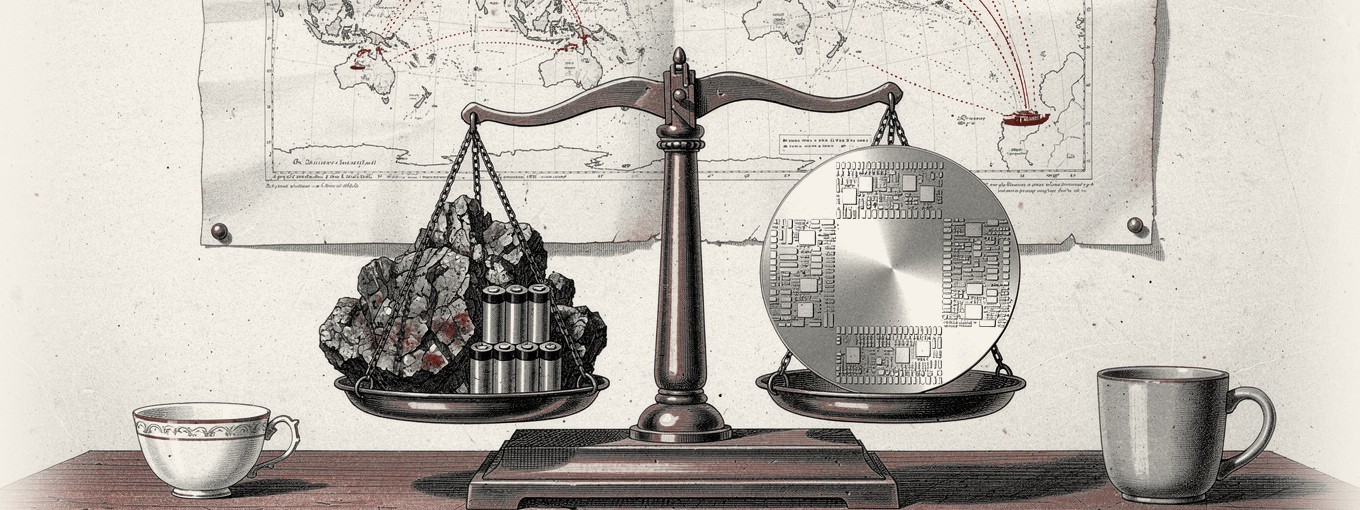
Upstairs, the pain switches sides. Between 2021 and 2024, 71% of the processed rare earths that the United States imported came from China. In graphite and antimony, China supplies about half of U.S. consumption. In lithium-ion batteries and the solar chain it concentrates 80 and 85% of the planet's capacity. And on the other side, in 2023 Chinese manufacturers barely covered between 9.6 and 15% of the chip-making equipment that its own country uses.
Washington can close the door to frontier technology for China. Beijing can close the door to the material with which that technology is manufactured for Washington. One controls the brain. The other, the bones.
That is why the two negotiate. And that is why the agreement does not eliminate the rivalry. It makes it legible.
They created a Trade Council to manage the lower floor and an Investment Council to remove obstacles. They opened a table for agricultural barriers, secured purchases of U.S. coal for 2027 and 2028, set up a dialogue on superintelligence with a hotline for incidents, cooperated against fentanyl precursors, and agreed that Iran cannot have a nuclear weapon. And they deliberately left out rare earths, Taiwan, Ukraine, North Korea, and frontier chips.
That is not a flaw in the agreement. It is its design.
Now it is your turn.
If you have a company in the United States, your risk is no longer with your supplier. It is with your supplier's supplier. In a magnet, in a graphite anode, in a gram of antimony that came from a Chinese refinery even if the invoice says another country. And if you sell lower floor products to the Chinese market, a window has opened that will not stay open by itself.
If you have a company in Mexico, the map is more uncomfortable. The Chinese products that could enter the United States with better treatment are exactly those that Mexico was starting to replace. At the same time, Mexico raised tariffs of up to 50% on 1,463 tariff lines from countries without a treaty, and its Chinese inputs became more expensive. And on September 11 the president Trump said that he would accept Chinese automakers in the United States, but not in Mexico to export north. Nearshoring is not over. It changed its rules.
China is racing to replace the equipment, chips, and technology that the West sells it today. The United States is racing to replace the refining, minerals, and batteries that China sells it today. The one who arrives first will have a free hand in the next crisis.
And the company that understands this race before its competition will decide where to invest, who to buy from, and who to sell to with an advantage that does not appear in any press release.
The future of this relationship will not be decided at a summit. It will be decided in mines, in chip factories, in refineries, in laboratories, and in ports.
Also in your supply chain.
Simón Levy